Checking whether a Chinese company is legit means answering four separate questions: is it a real registered entity, is that registration still valid, is it the entity it claims to be, and will it receive your money as itself. A business licence only answers the first. Most buyers who lose money in China had a licence in hand — the failure was in the other three.
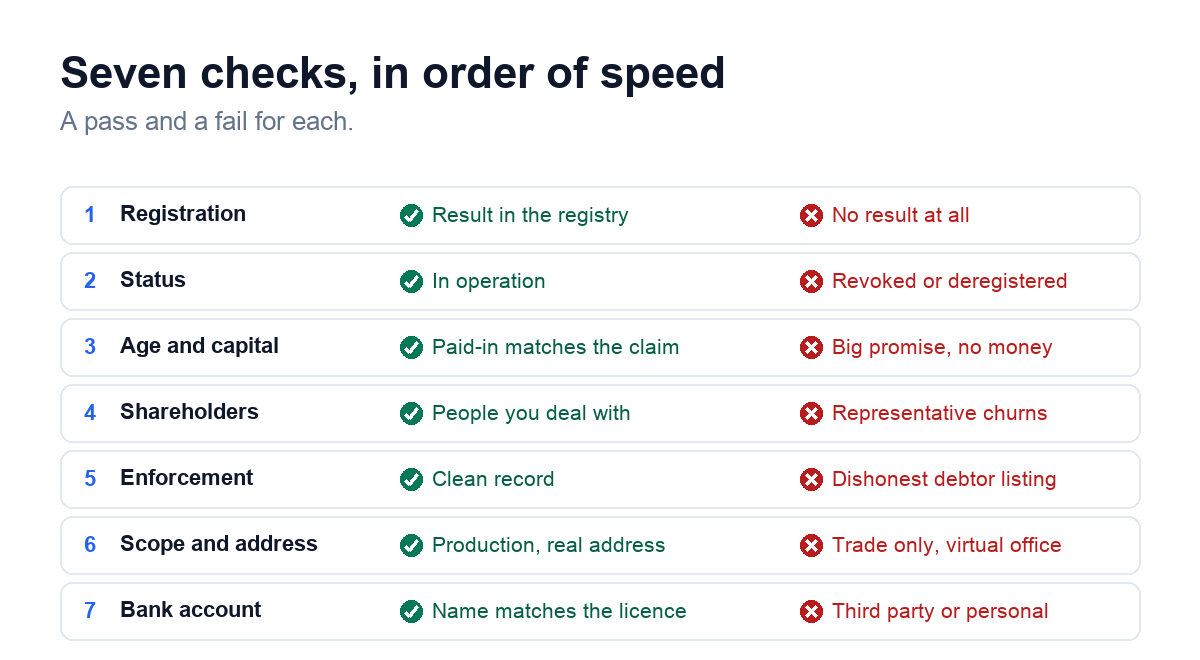
Here are the seven checks we run, in the order that finds the most problems fastest, with what a pass and a fail look like for each.
Last updated: November 2026
The four questions behind “legit”
| Question | What answers it | What it does not tell you |
|---|---|---|
| Does the company exist? | Business licence, registry search | Whether it still trades |
| Is the registration still valid? | Registry status (在业 / 吊销 / 注销) | How it pays its debts |
| Is it who it says it is? | Name, address, business scope, shareholders | Whether the person emailing works there |
| Will payment reach it? | Bank account name vs licence name | Whether the goods will ship |
A supplier can pass the first two and fail the last two, and that is the most common pattern in the cases that end in loss.
1. Registration: does the entity exist?
Search the exact Chinese name in the national registry (gsxt.gov.cn), or the Unified Social Credit Code if you have it.
Pass: a result page with status, legal representative, establishment date, shareholders and business scope. Fail: no result, or a result that shares the name but not the address, industry or legal representative your contact described.
If you do not have the Chinese name yet, that is the first job — see how to look up a Chinese company by name.
2. Status: is it still legally alive?
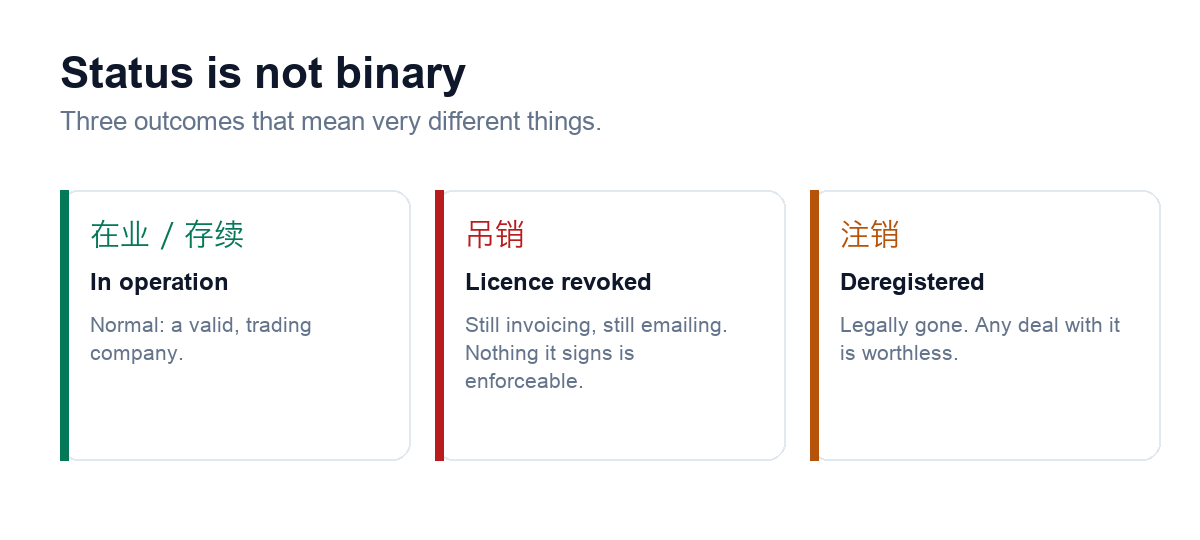
Registry status is not binary, and the distinctions matter:
| Status | Meaning | Buyer impact |
|---|---|---|
| 在业 / 存续 | Operating | Normal |
| 注销 | Deregistered | The entity is gone; any contract is worthless |
| 吊销 | Licence revoked, not deregistered | The trap. Website live, staff responsive, invoices issued, licence cancelled |
| 清算 | In liquidation | Assets are being distributed |
| 停业 | Suspended | Not trading |
吊销 is the one that catches foreign buyers. The company keeps its registry page and its sales team; the regulator has cancelled its licence, usually for failed annual filings or serious violations.
3. Age and capital: is it as substantial as it claims?
Pass: establishment date consistent with what the supplier says, and a registered capital figure that the annual report shows was actually paid in. Fail: registered last year while claiming fifteen years in the market; registered capital of ¥100 million with a paid-in figure near zero.
Chinese registration uses a subscribed-capital system (认缴制): the registry records the amount shareholders promised to contribute, not the amount they paid. Paid-in capital appears in the annual report, and since the revised Company Law took effect in July 2024 companies have had to align their contribution schedules within a transition period ending June 2027. A large registered figure set years ago tells you almost nothing until you read the annual report.
4. Shareholders and the legal representative
Pass: shareholders and the legal representative match the people you are dealing with, or there is a documented corporate parent. Fail: the legal representative changes every few months, or the person negotiating appears nowhere — not a shareholder, not the legal representative, not a listed contact.
Frequent changes of legal representative are a recognised pattern in front companies: the role carries liability, so entities built to absorb risk are abandoned and replaced. Ask for a signed authorisation (授权委托书) if your contact is not on the registry.
5. Enforcement and litigation: does it pay?
Three sources, in descending order of signal:
- zxgk.court.gov.cn — companies that failed to comply with court orders. A listing as a dishonest judgment debtor (失信被执行人) is the strongest public sign that a company has stopped paying its obligations.
- wenshu.court.gov.cn — published judgments. Coverage is partial, so an empty result is weak evidence of a clean record, while a hit is strong evidence of a problem.
- creditchina.gov.cn — administrative penalties, blacklists and tax-credit downgrades.
Pass: no enforcement records, no recent penalties. Fail: any dishonest-debtor listing in the last two years, or a pattern of quality or safety penalties.
6. Address, business scope and the factory claim
Pass: the registered address is a real, identifiable location, and the business scope lists production (生产 / 制造) if the supplier claims to be a manufacturer. Fail: scope limited to 销售 (sales) or 贸易 (trade) while the supplier insists it owns the factory; a shared or virtual-office address; an address inside an office tower for a claimed plant.
Trading companies are legitimate. Being invoiced by a trading company while believing you are buying from the factory is the problem — it changes your recourse, your pricing and your leverage.
7. The bank account: will the money reach the company?
The single most important check, and the one the registry cannot do for you.
Pass: the account holder name matches the registered legal name, character for character, and the bank is a mainland Chinese bank the company can explain. Fail: a personal account, a third-party account, a Hong Kong company account when you contracted a mainland entity, or crypto.
None of these is automatically fraud. All of them mean that if the goods never arrive, you have no claim against the entity you thought you were buying from.
The three deceptions that pass a licence check
The borrowed licence. A real company’s licence is shown to you; the invoice and the bank account belong to someone else. Every document is genuine except the connection between them.
The agent posing as the factory. The licence is real and the factory is real, but they belong to different companies. You pay the agent; the factory has no idea you exist.
The revoked-but-live company. 吊销 status, website still up, staff still answering. Nothing about the pitch is false except that the licence was cancelled.
All three survive a casual licence check. All three are visible in the registry and the bank details within an hour.
Free checks versus a report
The free sources above cover registration, status, enforcement and penalties. What they do not do is assemble the picture: several layers of ownership, the annual reports, the judgment and penalty history read together, and the judgment calls about which records matter.
A report makes sense when the deal is larger than the report — a new supplier with a five-figure order, an entity introduced through a platform, a company registered in the last two years, or any situation where you cannot read the Chinese records yourself.
FAQ
Can I check a Chinese company for free? Yes — registration, status, enforcement and penalties are all public. The costs are language, captchas and knowing which of six systems to look at.
Does a business licence prove a company is legit? No. It proves the company is registered. It says nothing about whether it pays its debts or whether your payment reaches it.
How do I know if a Chinese company is a scam? Most cases are not fake companies but real companies used badly. Check status (吊销), enforcement records and the bank account name; those three catch the majority.
Is a trading company less legitimate than a factory? No. It is a different role. The problem is only when the role is misrepresented.
Minimum viable check
Status in the registry. Enforcement records. Business scope against the factory claim. Bank account name against the licence. Four steps, under an hour, and they catch most of what goes wrong.
For the full record set in one English document, order a China company verification report — $39.99, delivered within 12 hours, sample here. The longer step-by-step method is in how to verify a Chinese company, and the source-by-source detail is in our verification hub.
Written by the China Company Check research team. Registry and enforcement data reflect official records at the time of writing.