A China company search by name means querying the government’s national enterprise registry (gsxt.gov.cn) with a company’s exact Chinese name to retrieve its registration status, legal representative, shareholders, capital and registered address. It is free, it is the same data Chinese banks and courts use, and it takes about ten minutes — the hard part is getting the exact name to search with.
This guide covers the free method end to end: how to turn an English trade name into a searchable Chinese one, what the result page actually tells you, and where the free records stop.
Last updated: November 2026
First: the name you have is probably not searchable
Chinese companies carry two names, and only one of them is in the registry:
- The trade name on the website, Alibaba store, catalogue and email signature — often English, often invented (“Shenzhen Skyline Electronics”).
- The registered name in Chinese — 深圳市天源电子有限公司 — which is what the registry indexes.
Searching the English name returns either nothing or a similarly named company in the same city that has nothing to do with your supplier. There is no fuzzy matching across languages, and no English-language version of the registry.
So every free search starts with the same question: what are the exact characters?
Three ways to get the exact name
Ask for it. Request the full legal name in Chinese, plus a photo of the business licence (营业执照). Any real Chinese company has both within reach; refusing or delaying is itself information.
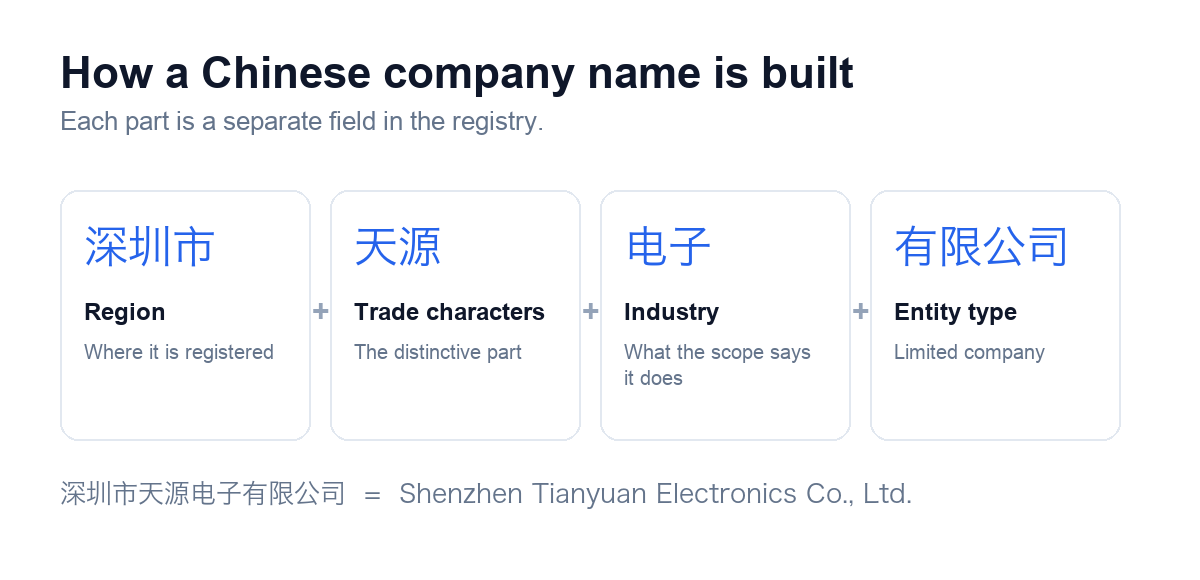
Reconstruct it. Chinese names follow a fixed pattern — region + trade characters (字号) + industry + 有限公司. If you know the city, the industry and the pinyin of the brand, you can build a shortlist of plausible names and search each. A name like 深圳市天源电子有限公司 reads: Shenzhen, 天源, electronics, limited company.
Search the person. If you have the legal representative’s name (法定代表人) from a contract or a licence scan, searching it in the registry returns every company that person is attached to — often revealing the same supplier operating several near-identical entities.
What the free registries cover
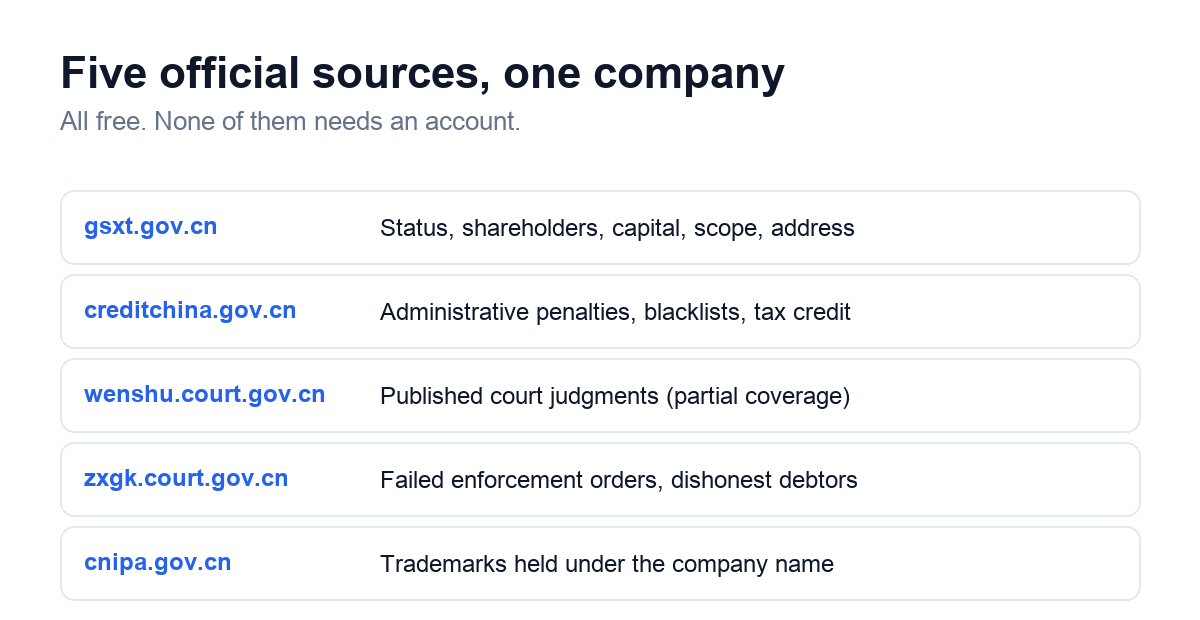
Five official sources do almost all the work. None of them require an account, a payment or a Chinese phone number to read the pages; some require a captcha.
| Source | What it answers | Best for |
|---|---|---|
| gsxt.gov.cn — National Enterprise Credit Information Publicity System | Status, legal representative, shareholders, registered capital, address, business scope, annual reports | The core record. Start here |
| creditchina.gov.cn — Credit China | Administrative penalties, blacklists, tax-credit ratings | Whether the company is in trouble with regulators |
| wenshu.court.gov.cn — China Judgements Online | Published court judgments | Commercial disputes, with incomplete coverage |
| zxgk.court.gov.cn — Enforcement disclosure | Court orders the company failed to comply with | The strongest signal of payment risk |
| cnipa.gov.cn — Trademark register | Trademarks held under the company’s name | Whether the brand it sells is actually its own |
Step by step: the search itself
- Open gsxt.gov.cn and paste the exact characters, including 有限公司. Partial names return long lists and usually the wrong company.
- Solve the captcha. Some records additionally require phone verification, which is a limitation for foreign buyers — if the page will not load at all, that is a network issue, not evidence the company does not exist.
- Prefer the Unified Social Credit Code (统一社会信用代码) when you have it. The 18-character code identifies one entity exactly; a name can match five.
- Read the result page in this order: status → establishment date → legal representative → registered capital → shareholders → business scope → penalties tab.
- Cross-check the four documents — licence, contract, invoice, bank account — for the same characters before any payment.
Reading the result page
The fields that matter, and what each one is actually telling you:
| Field | Looks like | What it means |
|---|---|---|
| Status | 在业 / 存续 | In operation. The good case |
| Status | 注销 | Deregistered. The entity is legally gone |
| Status | 吊销 | Licence revoked but not deregistered — the trap. The company can still send invoices |
| Establishment date | 2019-04-12 | A company registered months ago with no trading history is a different risk profile |
| Registered capital | ¥5,000,000 | A subscribed promise, not money in the bank. Paid-in capital is in the annual report |
| Business scope | 销售 / 贸易 / 生产 | 贸易 and 销售 mean trading, not manufacturing, regardless of the company’s marketing |
| Shareholders | Two natural persons | Ownership structure. A single shareholder registered last year is thinner than it looks |
Where the free records stop
Free data answers “does this company exist and what is its status”. It does not answer three questions that decide most deals:
Who really controls it. Registered shareholders are individuals or companies; those companies have their own registrations, and the chain can run several layers deep. Free registry pages show one layer at a time.
Whether it pays its debts. Enforcement records are public, but they are spread across courts and only partially published. A clean judgement search is weak evidence of a clean record.
Whether the entity you are paying is the entity you are dealing with. The registry cannot tell you that the bank account belongs to a different company — only the account details can.
That is the boundary between a free lookup and a verification report: the lookup tells you what is registered; the report assembles what the registration, court and regulatory records say together, in English, and flags the mismatches.
Common failure modes
No results at all. Usually one of: the name is a trade name, the entity is registered in Hong Kong (a separate registry) rather than mainland China, or the licence belongs to a company that has been deregistered long enough to drop out of search.
Too many results. Names are not unique. Filter by city and by establishment date, and compare the legal representative against whatever your contact has told you.
The name resolves but nothing else fits. Different address, different industry, different shareholders from what the supplier claims — treat it as a different company until proven otherwise.
FAQ
Is the Chinese company registry free to use? Yes. gsxt.gov.cn and the other official sources are free. The costs are time, Chinese-language navigation and captchas.
Can I search by English name? Only if the company has registered an English name, which is uncommon for small and mid-sized suppliers. Otherwise you need the Chinese characters.
Do I need the Unified Social Credit Code? No, but it is the fastest way to avoid picking the wrong company from a list of similar names.
Is a company with a business licence automatically safe to trade with? No. A licence proves registration, not solvency, not ownership of the factory, and not that the bank account you were given belongs to the company.
Do it once, then decide
Paste the exact name into gsxt.gov.cn, read the status and the business scope, then confirm the same characters on the invoice and the bank account. That is the free baseline, and it catches most of the problems buyers actually encounter.
If you need the layers the free lookup cannot show — ownership chain, litigation, enforcement and penalties in one document — order a China company verification report for $39.99, delivered within 12 hours. You can see a sample first, read the full verification method, or how we check each source. If you are still working out the exact name, start with how to find a Chinese company’s legal name.
Written by the China Company Check research team. Registry status reflects official records at the time of writing; company details change and should be re-checked before payment.