A Chinese company chop is a business seal used on company documents; its image alone cannot establish authenticity or signing authority. Before relying on a stamped contract, match the seal’s company name to the contracting entity, verify who is authorised to act, confirm the final document through an independent company channel and preserve the evidence.
This guide helps overseas buyers understand company seals, recognise issues worth investigating and ask better questions before signing. It is a procurement checklist, not a forensic seal examination or a legal opinion on whether a particular agreement is enforceable.
What is a Chinese company chop, and why does it matter?
A chop is a seal used to represent a company or a particular business function on documents. It can be important evidence of a company’s participation, but a contract decision should consider identity, authority, document content and the surrounding facts together.
Are there different types of company seals?
Companies may use a general company seal, a contract seal, financial or invoice seals and a legal representative’s personal seal. Their functions differ. A mark used for financial administration should not simply be treated as interchangeable with a company seal for all commercial agreements.
The China Briefing overview of company chops explains common types and their use. For a particular agreement, ask which seal is being used, whose seal it is and why it is appropriate. Avoid judging authority from a seller’s English description such as “official stamp” alone.
Does every Chinese contract need a company stamp?
Do not use that as a universal legal rule. Contract formation, representation, agreed formalities and particular legal requirements can raise separate questions. Article 490 of China’s Civil Code addresses contracts made in written form and also recognises circumstances involving accepted performance.
“Where the parties conclude a contract in the form of a written agreement, the contract is formed at the time when the parties all sign, stamp, or put their fingerprints on the memorandum.”
Article 490, Civil Code English text reproduced by Trans-Lex
This general provision is not a shortcut for deciding whether a specific contract is valid or whether a representative had authority. For a substantial, unusual or disputed agreement, obtain advice from a qualified Chinese lawyer about the document and facts. A buyer’s visual checklist cannot resolve those legal issues.
What can a stamp’s appearance tell you?
Appearance can help identify discrepancies that deserve investigation. It cannot prove that a seal is registered, was applied by an authorised person or represents the company’s agreement to the final terms.
Which visual details are worth comparing?
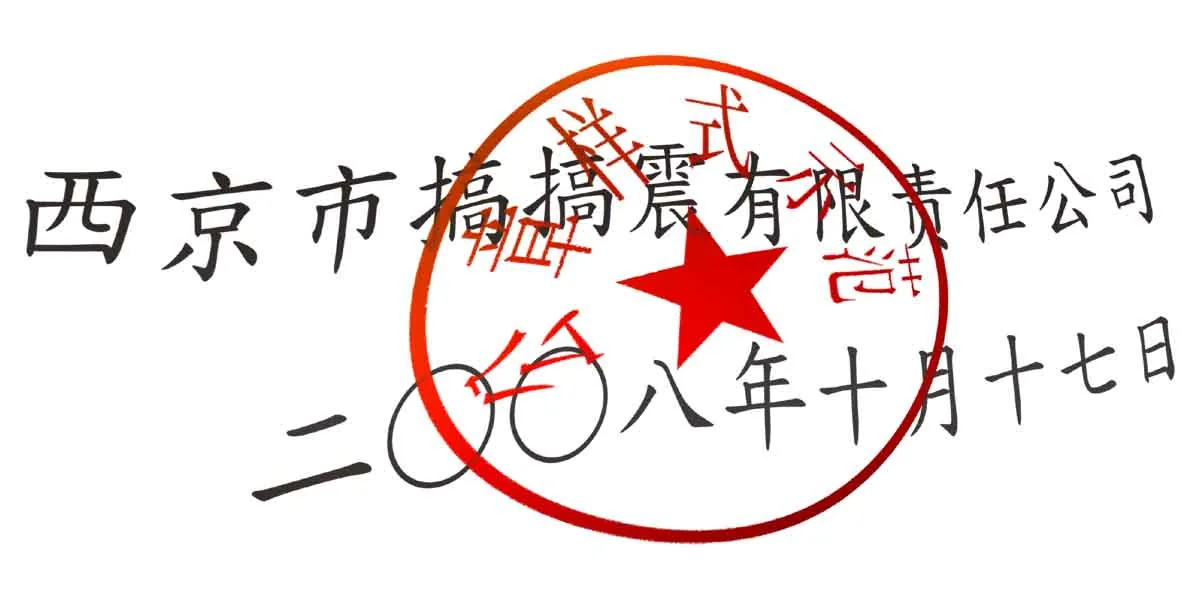
Read the full Chinese name around or within the seal and compare it with the company’s registered name. Note any wording identifying a contract or other specialised seal. Check whether the imprint is legible and whether pages or attachments refer to the same entity. If a code appears, preserve it exactly for further review rather than assuming what it represents.
The EU SME Centre’s practical guidance on recognising company chops describes common characteristics, including Chinese company names and variations in format. Use such guidance to frame questions. It is not an online authentication service for your particular stamp.
Which appearance-based conclusions should you avoid?
Do not say that every genuine seal must have the same shape, every imprint must contain an 18-character company code or every imperfect scan is forged. Different seal types and image quality create variation. Likewise, a perfectly circular red stamp with correct characters can be copied into a PDF.
Think of a seal image like a signature specimen: it provides something to compare, but the circumstances of its use still matter. A salesperson sending you a stamp graphic has not demonstrated that the company authorised the final contract. Request confirmation of the actual agreement, not merely another clearer image of the same mark.
How do you check a Chinese company stamp on a contract?
Check the entity, document and authority in a sequence that leaves an evidence trail. Treat unanswered questions as open issues rather than approving the document because the stamp looks plausible.
Use this six-step workflow
- Obtain the complete final contract, including specifications, schedules, price, delivery terms and any referenced attachments.
- Record the contracting party’s exact Chinese registered name and Unified Social Credit Code. Confirm current company identity through independent records.
- Read the seal name and compare it with the contract party. Investigate abbreviations, former names or another company’s name instead of treating them as interchangeable.
- Identify the signatory and their role. If the person is acting under delegated authority, request the relevant authorisation and verify it through a reliable company channel.
- Confirm that the company approves this exact final version, using contact details independently established from the company relationship or other reliable sources.
- Retain the final file, original where applicable, correspondence, verification sources and dated explanation of any mismatch before committing funds.
For registration and identity matching, our Chinese company lookup guide provides the separate company-record process. Keep that work distinct from a claim that a stamp has been forensically authenticated. Confirming that Company A exists does not prove who applied its seal to your document.
What does independent confirmation mean in practice?
It means avoiding a closed loop in which the same unverified salesperson supplies the stamp, authorisation letter, company phone number and confirmation. Use a contact channel you have independently established for the company. Where practical, ask an authorised company contact to confirm the contract reference, date, version, contracting name and representative.
For higher exposure, a lawyer or appropriately qualified local professional may need to review originals, authority documents and available seal-verification procedures. There is no single public website where an overseas buyer can upload any stamp image and reliably receive a universal “genuine” result. Be cautious of tools that claim otherwise without explaining their evidence.
How should you check signing authority and name mismatches?
Establish which legal entity is accepting the obligations and why the person signing can act for it. A correct-looking stamp does not resolve a mismatch between the seller, factory and contracting party.
Must the legal representative personally sign?
A company can act through people other than its registered legal representative, but the authority and circumstances need review. Do not reject every salesperson’s signature automatically, and do not assume every employee can bind the business to any agreement. Ask for the basis of the person’s authority and confirm the arrangement independently.
An authorisation letter should be assessed in context: who issued it, which entity it represents, the named authorised person, the relevant transaction or scope and any period or limits. A PDF carrying another unexplained seal merely shifts the question to a second document. Where authority matters materially, have the chain reviewed rather than collecting more graphics.
What if the seal belongs to another group company?
Consider a hypothetical contract naming Company A while the seal names Company B. The seller explains that B owns the factory and A handles exports. That can describe a real commercial structure, but it does not establish that the document clearly allocates responsibility. Determine which party sells, manufactures, receives payment and bears the obligations.
Do not simply replace a name in one field and keep the rest unchanged. The agreement, schedules and payment documents may need coordinated correction or a documented multiparty arrangement. A corporate relationship is not a reason to ignore legal separation. Review a sample company background report to see the types of identity and ownership information that can support this investigation; document availability varies.
| Finding | What it establishes | Next question |
|---|---|---|
| Seal name matches registered company | Names appear consistent | Who applied it, and was the final contract approved? |
| Signatory is the recorded legal representative | Role matches the available record | Are the identity, agreement and applicable formalities confirmed? |
| Signatory presents an authorisation letter | There is a claimed delegation | Is it genuine, current and sufficient for this transaction? |
| Another group company’s seal appears | A different entity is involved | Who is accepting each contractual obligation? |
| Only a pasted seal image is available | A graphic appears in the file | What independent evidence confirms company approval? |
Are scanned or electronically signed contracts acceptable evidence?
Electronic documents can be relevant, but the method of execution and the quality of the evidence matter. A scanned seal, a reliable electronic-signature process and an unsigned editable document are not the same thing.
Distinguish the document format from the signing process
A PDF is a file format. It does not tell you whether a physical original exists, whether a graphic was inserted or whether a signing platform produced an audit trail. Ask how the parties executed the agreement and what records are available. Where electronic signing is used, retain the validation and audit information provided by that process.
Whether a particular method satisfies relevant law and the agreed formalities depends on the circumstances. Do not use “all scans are invalid” or “any electronic stamp is valid” as procurement rules. For important agreements, agree the execution method with legal advice before the deadline, rather than discovering an evidence gap during a dispute.
Be equally careful with an “approval” message that does not identify the version. If the company confirms only that it has a business relationship with the salesperson, that does not necessarily confirm a later change in price, delivery or liability. Ask for approval of the exact document reference and attachments. Keep the reply with that version rather than in a separate chat history that the purchasing team cannot access.
Agree a process for amendments as well as the initial signature. Changes to bank details, quality specifications or the contracting party deserve review even if the original agreement was properly executed. A familiar seal image copied onto a revised invoice does not remove the need to verify the underlying change.
What should you preserve after signing?
Keep the final unaltered contract, each annex, version reference, correspondence confirming approval, signing records and originals where applicable. Record changes after signing separately. If a specification is replaced, make clear which version now governs and how both parties accepted the change.
A seal across pages may help associate a bundle, but it is not a substitute for clear version control. Check page counts, attachment names and references. Store the complete agreement in a stable format accessible to the people handling purchasing, quality and claims. A screenshot of the signature page without the underlying terms is a weak operational record.
What should you do if a company chop looks suspicious?
Pause reliance on the disputed document and seek an evidence-based explanation. Avoid either dismissing a legitimate document on appearance alone or proceeding under pressure with unresolved identity and authority issues.
Resolve the specific issue before payment
If the Chinese company name differs, request the reason and supporting company records. If authority is unclear, confirm it independently. If pages have changed, request a clean complete final agreement and confirmation of its version. If authenticity remains contested, involve a qualified professional who can examine the relevant evidence.
Do not send funds merely because the supplier offers to add another stamp. Also review beneficiary identity separately using our bank-account mismatch checklist. A valid contract seal does not prove ownership of a bank account or authorise an unexplained last-minute change of recipient.
A practical clarification request might say: “The contract names Company A, while the seal appears to name Company B. Please confirm the full Chinese registered name of the party accepting this agreement, identify the authorised signatory, and explain the role of each company. Please also confirm that your approval covers contract version X and attachments Y and Z.” This asks for a resolvable explanation without accusing anyone of forgery.
If a dispute has already arisen, avoid editing the original files or discarding earlier versions while trying to tidy the record. Preserve what you received and seek advice on evidence collection and next steps. A new corrected document can help clarify future arrangements, but it should not erase the history of what was previously represented.
Know when a background report helps
Company-record research can clarify registered names, legal representative information, ownership links and available risk records. It can help identify the business described on the agreement. It cannot certify that a particular physical seal is genuine or decide whether a representative legally bound the company.
You can request a company background check for that identity layer. If your decision requires seal authentication, contract drafting or an enforceability opinion, obtain specialist legal assistance. Keep each finding within its scope: company existence, stamp appearance, authority and contract performance are connected questions, but they require different evidence.
The practical goal is a coherent contracting record. You should be able to name the company, explain who acted for it, identify the agreed document and show how approval was confirmed. That is much stronger than a folder containing an impressive red mark and an unanswered question.
Frequently asked questions
Q: Can I verify a Chinese company chop online?
A: Online company records can help compare the Chinese name and legal representative, but they do not universally authenticate a seal image. Verification procedures and available evidence vary. For a significant transaction, use independent company confirmation and professional review where needed rather than an image-only “real or fake” result.
Q: Does a red round stamp prove a Chinese contract is valid?
A: No. It is a common visual form, not a complete legal test. Identity, authority, agreed terms, execution requirements and the circumstances matter. A copied graphic can look convincing, while legitimate documents can use different seal types. Obtain legal advice for the particular agreement if validity is material.
Q: Should the company name on the chop match my supplier?
A: It should be consistent with the relevant contracting entity or have a documented explanation that fits the agreement. A brand name, affiliate and manufacturer are not automatically the same legal person. Investigate a mismatch and clarify obligations before relying on the contract or making payment.
Q: Is a company verification report enough to authenticate a stamp?
A: No. A report may help establish the company’s registered identity and available background information. It does not examine the physical seal, prove who applied it or provide a contract-enforceability opinion. Use specialist legal or forensic assistance if those are the questions your transaction requires you to resolve.
Sources reviewed 22 November 2026. General procurement information only; seek advice on the law and facts of your agreement.