
How to pay Chinese suppliers safely: verify the seller and beneficiary, agree payment milestones, compare the full delivered cost, and release funds only when the agreed evidence is complete.
This guide helps US importers choose a payment method without confusing a successful transfer with a protected purchase. It compares bank transfers, payment platforms, escrow, letters of credit, and supplier credit; explains USD versus RMB quotes; and shows how to connect deposits and balances to measurable conditions. You will also find a prepayment checklist, a procedure for changed bank details, and questions to send your supplier. Company verification, bank account confirmation, and product inspection answer different questions. Use them together, with controls proportionate to your order, rather than treating any single document or service as proof that a transaction is safe.
Cover: Hong Kong container port, photographed by Timelab / Unsplash (cropped). Contextual photo, not a supplier or customer case.
1. Which payment method should you use?
Choose according to order exposure, supplier history, and enforceable protection. A lower transfer fee does not compensate for sending an unprotected advance to an unverified recipient.
Compare the transfer method with the protection behind it
T/T means telegraphic transfer, commonly used to describe an international bank transfer. SWIFT helps banks exchange payment messages; it does not certify the supplier or inspect your goods. A regulated cross-border payment service can offer another transfer route, but its business eligibility, receiving arrangements, and permitted transaction types need checking.
| Method | Useful situation | Protection limit to check |
|---|---|---|
| Bank transfer / T/T | Documented business invoices and staged payments | No automatic product dispute protection; recall is uncertain |
| Cross-border payment platform | Comparing conversion costs and supported business payouts | A transfer service is not necessarily escrow or purchase protection |
| Card or marketplace payment | Eligible samples and platform-covered orders | Coverage, exclusions, deadlines, and evidence vary |
| Escrow | Transactions with clear release conditions | Provider terms must cover the goods and inspection dispute |
| Letter of credit | Larger orders where bank administration is justified | Payment depends on compliant documents, not independent quality approval |
| Documentary collection | Established trade relationships with agreed document handling | Banks facilitate collection without guaranteeing payment or quality |
The US International Trade Administration’s payment guide explains how cash-in-advance, letters of credit, collections, open account, and consignment allocate risk. The important distinction is commercial: when does the seller receive money, and what can you require before that happens?
Match the method to the order
Start with the consequence of failure. If a delayed sample costs a week, a simple documented transfer may be reasonable. If a failed production run blocks a launch or leaves regulated goods unusable, build in independent inspection, a staged release, or bank-supported documents. Consider the supplier’s legitimate cash needs too: a control that makes production impossible is not a practical control.
For a sample, convenience may matter more than negotiating bank documents. For custom production, specifications and staged release matter more. For a substantial unfamiliar order, ask your bank whether a letter of credit is practical. The letter of credit overview explains the underlying documentary mechanism.
Do not assume an off-platform payment retains marketplace protection. Read the actual protection terms before moving a conversation or invoice outside the platform. The best way to pay Chinese suppliers depends on the transaction; no single provider is cheapest and safest for every buyer.
2. Should you pay in USD or RMB?
Compare written quotes for the same order and the same net amount received. Paying Chinese suppliers in RMB can change conversion costs, but it is not automatically cheaper than paying in USD.
Ask for comparable currency quotes
Put the quote request in writing so the comparison is reproducible. Specify whether the price is ex-works, FOB, CIF, or another delivery basis, because freight and insurance can overwhelm a small payment saving. Ask whether bank charges at the beneficiary bank are included and whether the supplier will treat any short receipt as an unpaid balance.
Request both currency options with identical quantity, specifications, delivery terms, and quote validity. Confirm whether the recipient accepts the proposed currency through the selected route. RMB is the currency name; CNY and CNH refer to onshore and offshore renminbi markets respectively. Do not substitute one receiving arrangement for another without provider confirmation.
If the supplier quotes only USD, ask whether that price already includes its conversion allowance. If it quotes RMB, calculate your actual dollar debit at an executable rate. A favorable headline rate is irrelevant when receiving fees leave the invoice short.
Calculate the full delivered cost
Include the transfer fee, foreign exchange spread, intermediary bank deductions, and beneficiary fees. With SWIFT payments, clarify the available fee instructions: OUR generally allocates charges to the sender, SHA shares them, and BEN allocates them to the beneficiary. Availability and actual deductions depend on the route; ask what amount the supplier will receive.
Illustration, not a market quote: if an invoice requires $10,000 net and one route costs $45 while another costs $15 plus a $60 conversion difference, their costs are $45 and $75. The smaller advertised transfer fee loses. This example assumes no additional deductions; obtain live quotes before deciding.
Record the quote time, expected arrival window, refund conditions, and the invoice reference. Why approve a transfer until you know whether it settles the full invoice?
3. Who are you actually paying?
Identify the contracting seller and explain the beneficiary relationship before transferring funds. Registration checks establish company information; they do not establish ownership of a particular bank account.
Check the legal company behind the trading name
Ask for the Chinese legal name, Unified Social Credit Code, business license, and contracting address. An English trading name alone can be ambiguous. Compare those identifiers across the contract, pro forma invoice, company records, and payment instructions. A factory, trading company, and export agent can perform different roles; understand which entity owes you delivery and any refund.
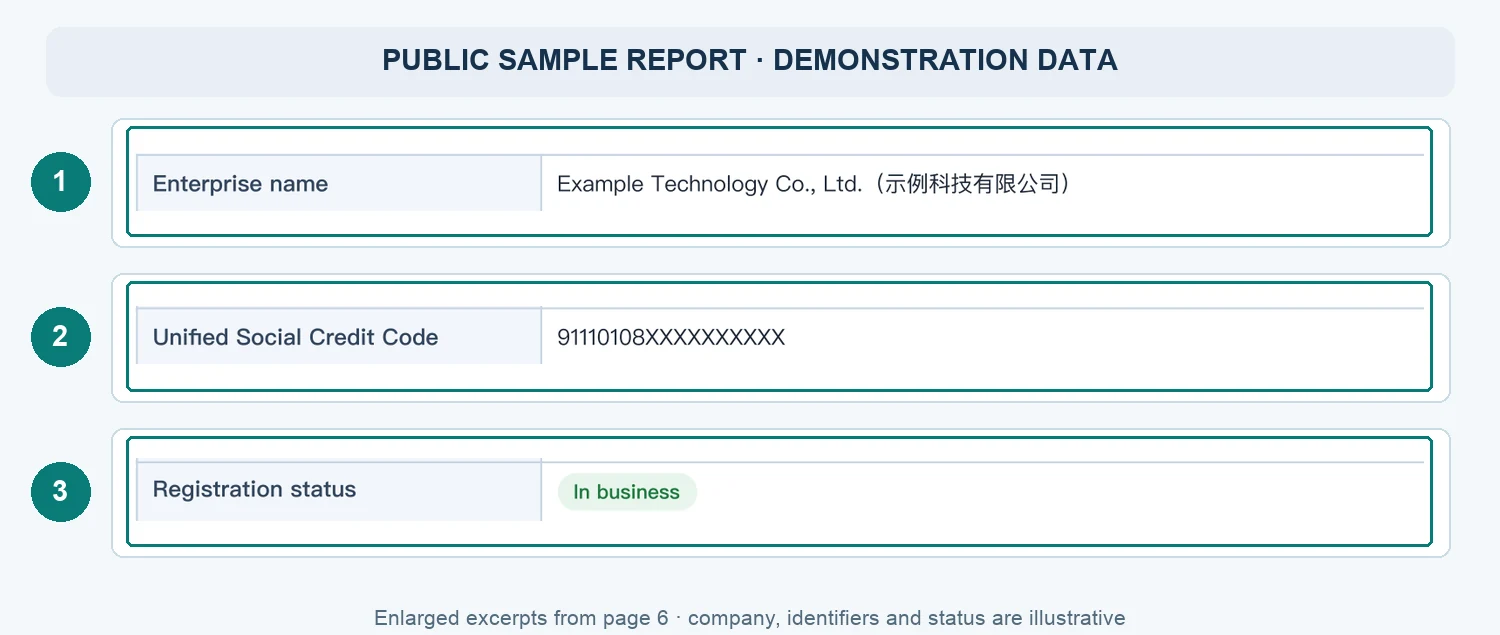
Review operating status and relevant public risk records. Litigation or a registration change needs context, not an automatic accusation of fraud. Equally, an active registration is not proof of production capacity. Use the company verification resources to plan the business checks, and commission a factory assessment when capability matters.
Resolve beneficiary mismatches before approval
Confirm the account name, account number, bank name, SWIFT/BIC, country, and currency using instructions your bank or provider can accept. A Hong Kong affiliate or collection agent may be legitimate, but the account location alone proves neither legitimacy nor fraud.
Ask why another entity receives payment, what authorizes it, and whether payment legally discharges your debt to the seller. Obtain the relationship and payment authorization in writing. Verify the explanation through independently sourced contact details. For material exposure, have your adviser assess the arrangement; a scanned letter is not independent bank confirmation.
Think of these checks as three separate locks: company identity, beneficiary authority, and goods acceptance. Opening one does not open the others.
4. How much should you pay upfront?
Negotiate the smallest workable advance and tie later payments to objective evidence. There is no universal deposit percentage that makes an order safe.
Understand common terms without treating them as rules
Payment terms are a negotiation about working capital and control. A supplier may request an advance to buy materials, while a buyer wants evidence before releasing the balance. Document the business reason for each stage and the remedy if a stage is missed. Do not copy another importer’s percentage without checking your own order’s materials, lead time, and loss exposure.
QualityInspection’s T/T payment guide, published November 17, 2023, describes a 30% deposit and 70% balance before shipment as a common arrangement. This is a practitioner example, not a current market survey or a requirement for every Chinese supplier.
| Structure | Published numeric example | Buyer’s implication |
|---|---|---|
| Production deposit and balance | 30% advance / 70% before shipment | Full payment can occur before possession; specify inspection before balance release |
| Open account | Typically 30, 60, or 90 days, per Trade.gov | Payment after delivery or shipment as contracted; supplier must accept buyer credit risk |
The open-account figures describe international trade generally, not a promise that a new Chinese supplier will offer credit. Tooling, customization, order size, and your trading history affect negotiation.
Make milestones measurable
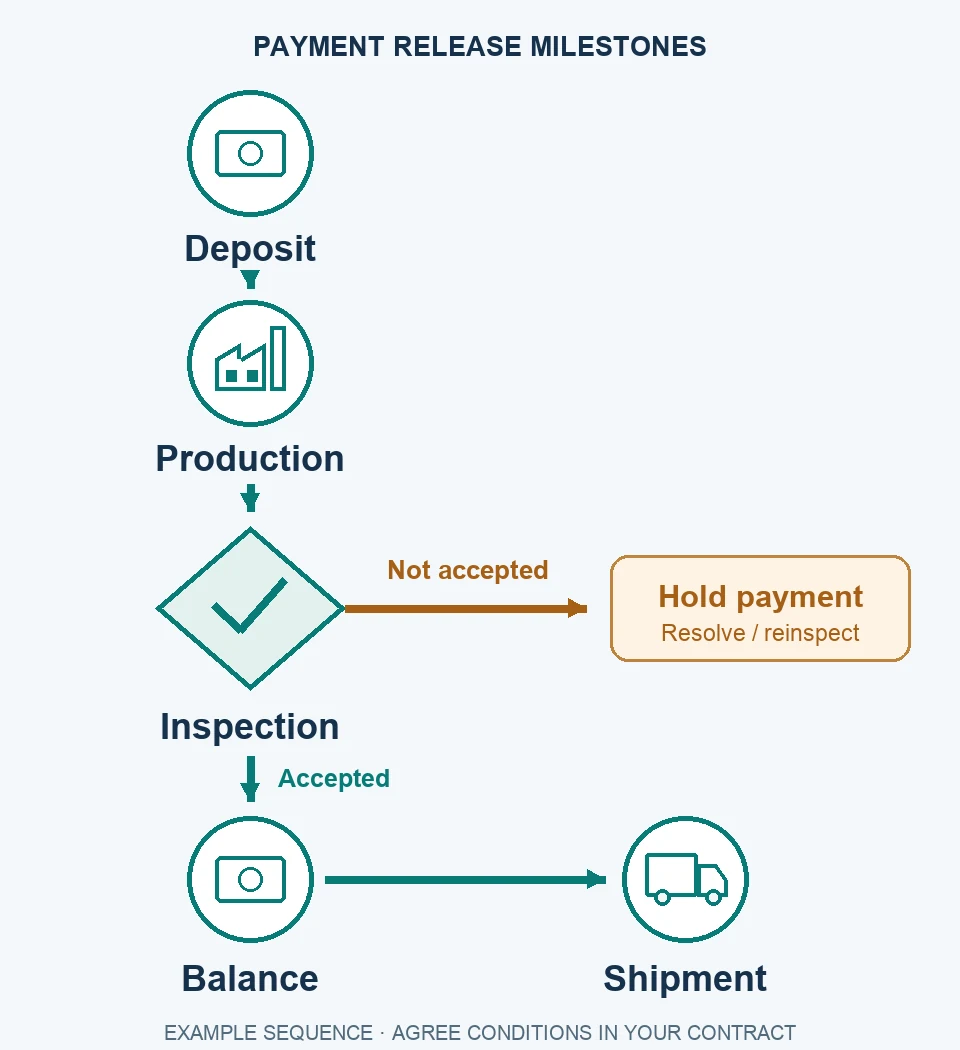
Write down the approved sample, material specification, quantity tolerance, inspection method, defect criteria, packaging, and shipment documents. Say who arranges inspection, who pays for a failed reinspection, and what happens when production misses the agreed standard. “Balance after quality approval” is too vague if nobody defines approval.
For example, a proposed balance condition could require a named independent inspection against an agreed checklist before release. This is a drafting example, not evidence of a completed transaction. Inspection reduces uncertainty but cannot guarantee every unit or replace product compliance testing.
“For importers, any payment is a donation until the goods are received.”
— International Trade Administration, “Methods of Payment”
The quotation captures advance-payment exposure. Treat a deposit as money at risk and negotiate evidence accordingly, while recognizing the supplier also needs workable production funding.
5. What should you check before sending money?
Use one approval record connecting the supplier, contract, beneficiary, quote, and release condition. Repeat the critical checks for each payment, including repeat orders.
Follow a practical approval sequence
Keep the approval record in a location that preserves versions. A changed PDF or replacement invoice should be visible rather than silently overwriting the approved copy. Include the person who approved the payment, the date, and the exact beneficiary fields. This simple history helps your bank, accountant, and supplier resolve a discrepancy quickly.
- Identify the seller. Record its legal name, registration identifier, and the person authorized to discuss the order.
- Finalize the order. Store the contract, specifications, invoice, currency, and agreed delivery terms together.
- Validate the recipient. Resolve mismatches and confirm payment instructions through a trusted channel.
- Compare the payout. Save the dollar debit, net receipt, fees, and expected arrival for the chosen route.
- Check the milestone. Obtain the evidence required for this deposit or balance, rather than reusing an earlier approval.
- Approve and reconcile. Where practical, separate preparation from approval; retain the transfer reference and request receipt confirmation.
A small test payment can expose routing problems, but it does not prove supplier honesty or product quality. Confirm its arrival before relying on it for account accuracy, and agree how it will be credited toward the invoice.
Know where a company report helps
A company report helps you review the entity behind the order. China Company Check offers a human-reviewed PDF covering registration, ownership, legal representative, and available public risk information. Review the sample company credit report to see its structure and limits.
The listed single-report price is $39.99, with delivery within 12 hours, checked on November 21, 2026. Check the current report pricing and delivery terms before ordering. Coverage depends on available records. A report is not bank account ownership verification, a factory inspection, escrow, or a payment guarantee.
6. What if the supplier changes its bank account?
Pause payment and independently verify the change. A familiar email thread, company stamp, or urgent shipping deadline is insufficient authorization.
Use a separate verification channel
A compromised mailbox can continue a genuine conversation. If the supplier cannot explain the change without urgency or secrecy, keep payment on hold.
Call a previously verified number, not one supplied in the change email. Confirm the request with an established contact and seek separate approval from the seller’s responsible representative. Compare the new beneficiary, account jurisdiction, currency, and reason for change against the contract. Update the approval record only after the discrepancy is resolved.
The FBI IC3’s business email compromise advisory recommends secondary channels to verify account-information changes. Its September 11, 2024 advisory reports 305,033 domestic and international incidents and approximately $55.5 billion in exposed losses for October 2013 through December 2023. Those are historical aggregate figures, not China-specific losses or a forecast of your transaction risk.
Act quickly if a payment looks wrong
Contact your bank or payment provider immediately and request fraud assistance and a recall where available. Preserve the original messages, invoice versions, transfer confirmation, and contact history. Follow the provider’s escalation instructions and report suspected fraud to the appropriate authorities; US victims can report to IC3. Recovery is not assured.
If the issue is a commercial quality dispute rather than payment diversion, use the contract and any applicable platform dispute process. Would another transfer solve the discrepancy, or simply increase your exposure? Do not send a replacement payment until you understand where the first one went.
7. Frequently asked questions
The right choice depends on the order and the protection you can actually enforce. These answers address common questions before a first supplier payment.
Q: How do I know if a Chinese supplier is legitimate?
A: Match its Chinese legal name and registration identifier to reliable company records, review operating status and relevant risks, and confirm who signs the contract. Check production capability separately when needed. Registration alone cannot prove that a sales contact controls the company or that a bank account belongs to it.
Q: Can I pay Chinese suppliers with a credit card?
A: Sometimes, if the supplier or platform accepts business card payments for that transaction. Compare fees, currency conversion, order limits, and the issuer’s dispute rules. A chargeback is not guaranteed compensation for a commercial dispute. Keep the written order and confirm whether the specific goods qualify for any advertised purchase protection.
Q: Is paying a supplier in RMB cheaper?
A: It can be, but compare equivalent supplier quotes and the final dollar cost. Include exchange rate markup, transfer charges, intermediary deductions, and receiving fees. Confirm the account accepts the currency through your chosen provider. An attractive RMB quote does not help if conversion or deductions make the invoice more expensive.
Q: Is a 30% deposit safe for a first order?
A: The percentage alone cannot establish safety. Consider the supplier’s identity, the loss you can absorb, agreed specifications, and the evidence required before the balance. Negotiate a smaller trial order or stronger release conditions where practical. A familiar deposit structure does not guarantee delivery, acceptable goods, or a refund.
Q: Should I verify the company before a repeat order?
A: Reconfirm payment details and the current order every time. Refresh company checks when the exposure rises, the relationship changes, or new concerns appear. An earlier successful shipment does not authenticate a new bank-change email. Keep the same approval discipline even when the sales contact and invoice template look familiar.
Knowing how to pay Chinese suppliers means connecting payment convenience with evidence and clear release conditions. If company identity is still uncertain, request a China company verification report before committing funds, and arrange the separate banking and product checks your transaction needs.